An extended version of this case study will appear in printed form in ECHTRAI JOURNAL, EDITION 4, due Spring/ Summer 2024
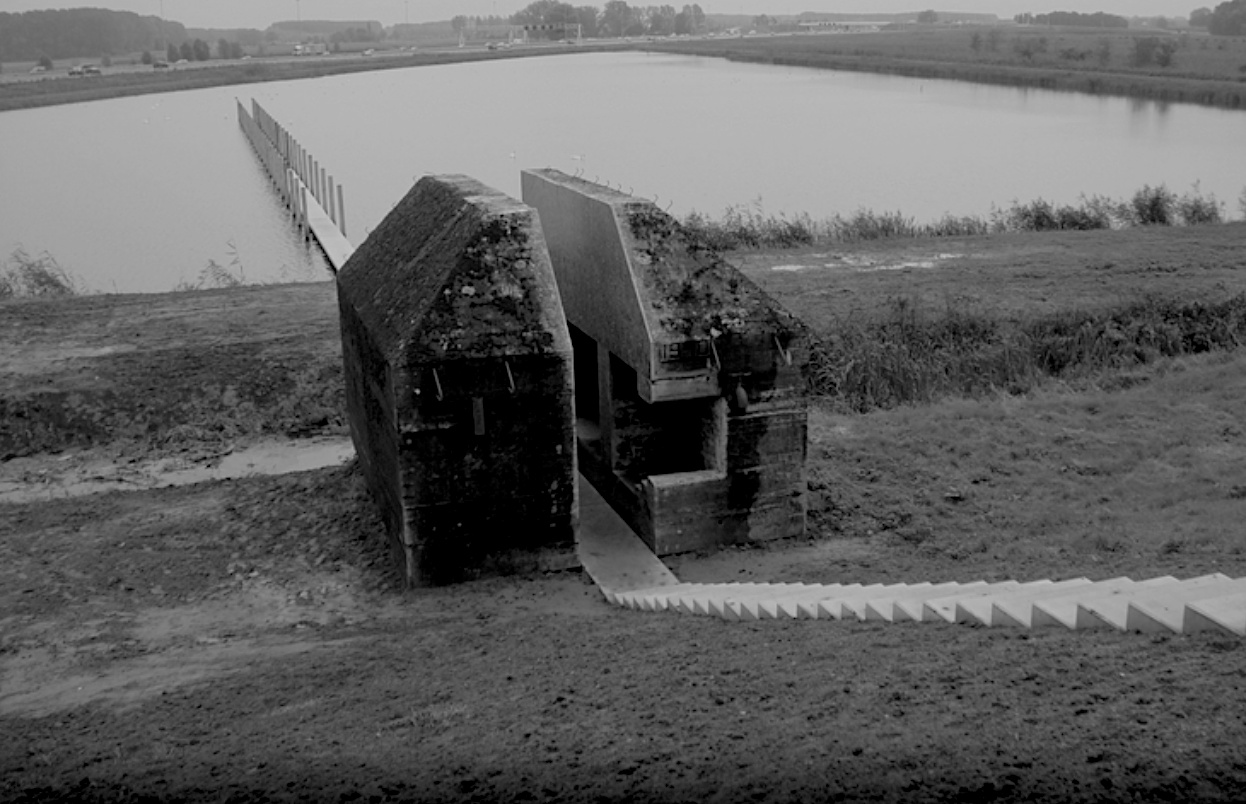
‘Bunker 599’ by Dutch firms Atelier de Lyon and Rietveld Landscape is a project which lays bare two secrets of the New Dutch Waterline (NDW), a military line of defence in use from 1815 until 1940 protecting the cities of Muiden, Utrecht, Vreeswijk and Gorinchem by means of intentional flooding. A seemingly indestructible bunker with monumental status is sliced open. the design thereby opens up the minuscule interior of one of NDW’s 700 bunkers, the insides of which are normally cut off from view completely. In addition, a long wooden boardwalk cuts through the extremely heavy construction. it leads visitors to a flooded area and to the footpaths of the adjacent natural reserve. the pier and the piles supporting it remind them that the water surrounding them is not caused by the removal of sand, but rather is a shallow water plain characteristic of the inundations in times of war. The sliced up bunker forms a publicly accessible attraction for visitors of the NDW. it is moreover visible from the A2 highway and can thus also be seen by tens of thousand of passers-by each day. The project is part of the overall strategy of the designers to make this unique part of dutch history accessible and tangible for a wide variety of visitors.
A bisected pillbox on the bank of a dyke opens a way through the sometimes impenetrable memories of war to a future of broader horizons..
It is not the most beautiful or obviously inspiring location in Holland, Europe, or the world, and yet the dot on the map at Culemborg where Bunker 599 broods alongside the lugubrious waters of the 13th-century Diefdijk, and faces the relentless mechanised roar of the Amsterdam-Maastricht motorway,is poignant, and oddly moving.
This reinforced-concrete bunker, erected in early 1940 as part of the Dutch defences against military invasion, has been split in two − cut through by steel wires like some giant, and untypically hard, Dutch cheese − and now acts as a framed viewpoint for passers-by who, stepping down from the roadway, pass through its mournful bulk out onto a wooden jetty, set between timber piles, to the very edge of the dijk, and a view across the motorway, electricity pylons and flat levels stretching away into an infinitely big sky.
There is no meaning here other than stopping to stare. Certainly, the remodelled Bunker 599 catches the eyes of walkers and cyclists. It is at once, or so it seems, a large-scale contemporary sculpture, or, perhaps − seen from a distance − some Neolithic standing stone. And just as those ancient and ineffable monuments draw us to them, as if magnetically, so this split concrete bunker, reconceived by Rietveld Landscape, with Atelier de Lyon, commands attention.
A part of the poignancy lies in the fact that, like its many sibling bunkers, pillboxes and canal-side defences, Fort 599 did nothing to stop the Germans from invading Holland in May 1940 and occupying the country in a few days. For all its ingenuity, the extensive system of water defences built from the mid-17th century to 1940 was unable to hold up an enemy who simply bypassed it. German paratroopers were dropped in their thousands on the other side of the 85 kilometre long Dutch Waterline, while the Luftwaffe reduced much of Rotterdam to rubble, threatening the same treatment for Amsterdam and other key cities unless the Dutch surrendered. They had no choice. So, all the ingenuity that went into the creation of a vast waterworks designed to flood the eastern Netherlands and so hold back invasions by Spanish, French and German armies, was ultimately to no effect.
Even then, the defences were shored up again after the Second World War, as if they might restrain the might of the Soviet armed forces at the outbreak of a much-feared Third World War. Holland may have fought brilliantly against the Spanish in the 17th century, but − especially because of its flat geography − it was to be no match for the sheer might of Napoleon and, later, Adolf Hitler. And, yet, today, the trade borne by all those articulated lorries thundering along the A2 motorway in view of Bunker 599 is a symbol of a Europe at peace, of boundaries pushed aside, of infinite possibilities.
This, too, is something to contemplate while looking through the fissure Rietveld Landscape have excavated through the warless concrete bunker, out into that level economic playing field, that boundless sky.
 AnMór Studio